
sales@aooser.com
13580725992
Against the rapid iteration of the global new-energy industry, all-solid-state lithium-ion batteries are regarded as the core technical direction for next-generation energy-storage and power batteries. They can fundamentally resolve the thermal-runaway risks of conventional liquid lithium-ion batteries, while substantially improving battery energy density, cycle life and wide-temperature adaptability. They boast broad application prospects in new-energy vehicles, special-purpose equipment, energy-storage systems and other fields. As the critical core of all-solid-state batteries, solid-state electrolytes directly determine the ionic-conduction efficiency, safety performance and service life of battery cells. Among them, NASICON-type oxide ceramic electrolytes stand out for their excellent air stability and broad electrochemical window, making them a key technical route prioritized by research institutions and industrial enterprises.
In recent years, domestic material enterprises have ramped up R&D investment, and tackled a series of process challenges including ceramic-electrolyte sintering, densification forming and purity control. They have realized the localized production of high-performance solid-state ceramic electrolytes, breaking overseas technical barriers for such materials and delivering solid material support for pilot-scale verification and small-batch production of domestic solid-state batteries.
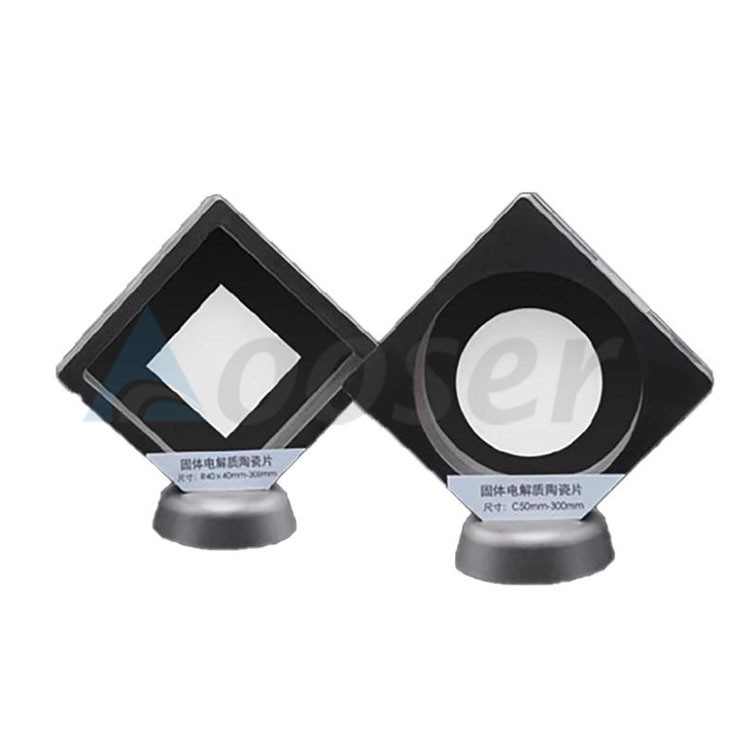
LATP (lithium-aluminum-titanium phosphate) and LLZO (lithium-lanthanum-zirconium-oxide) represent the two mainstream technical systems for oxide-based ceramic solid-state electrolytes. Featuring outstanding lithium-ion-conduction performance, LATP forms continuous lithium-ion migration channels within its crystal structure and delivers robust chemical stability. It is compatible with diverse advanced electrochemical systems such as all-solid-state lithium-ion batteries, lithium-sulfur batteries and lithium-air batteries. It can serve either as the main solid-state electrolyte or as a modified separator, suiting various R&D scenarios for batteries. As for LLZO garnet-structured ceramic electrolytes, their high ionic conductivity also renders them core materials widely studied in the solid-state-battery sector, suitable for the development of high-energy-density lithium-metal batteries.
Domestically produced high-performance ceramic-electrolyte products adopt strict controls over core indicators including material purity, densification and ionic conductivity. Their material purity reaches the 99.9% grade, keeping impurity content extremely low so as to avoid side reactions inside batteries triggered by impurities and enhance the cycling stability of cells. High densification of finished ceramic sheets enables efficient lithium-ion transport, with ionic conductivity meeting practical testing requirements for solid-state-battery R&D. In terms of product forms, standardized ceramic sheets come with well-established dimensional specifications, while customized dimensions are available to suit different scenarios ranging from lab-scale trials to pilot-line sample development. Each product is hermetically packed individually and comes with a one-year limited warranty, providing stable and reliable material supplies for universities, research institutes and battery-development enterprises.
Industry research indicates that the global solid-state-electrolyte market is undergoing rapid growth. The Asia-Pacific region has become its most important production and consumption market, with downstream demand mainly stemming from power batteries, energy storage, cutting-edge consumer electronics and other sectors. The number of domestic patents related to LATP and LLZO keeps rising. Preparation processes for powder materials and ceramic sheets are continuously optimized with improving batch-to-batch consistency. A growing number of battery enterprises have introduced oxide-based solid-state electrolytes into verification and testing for semi-solid and all-solid-state batteries, and several demonstration projects have been put into practical operation.
Nevertheless, the industrialization of solid-state ceramic electrolytes still faces multiple practical hurdles. Ceramics are inherently brittle. Interface-impedance management between electrolytes and electrodes, yield-rate improvement and cost reduction for large-scale manufacturing remain persistent challenges for the industry. Translating excellent lab-scale performance into engineering-grade products calls for joint efforts among material suppliers, cell manufacturers and research institutes to address the whole-chain technologies covering powder synthesis, ceramic forming and sintering, as well as battery-cell assembly.
According to industry experts, the solid-state-battery sector is currently in a critical transition phase from laboratory research toward engineering application. Semi-solid composite batteries will achieve large-scale commercialization in the short term, while massive commercial deployment of all-solid-state batteries requires sustained technical iteration. Mature supply of domestic high-performance ceramic electrolytes forms an important foundation for industrial progress. On one hand, high-quality ceramic sheets support universities and enterprises in conducting extensive fundamental verification experiments, accelerating the screening of material systems and cell-structure solutions. On the other hand, stable localized material supplies reduce domestic solid-state-battery R&D projects’ reliance on imported materials, cutting R&D cycles and material costs.
Looking ahead, with deepened collaborative innovation across domestic new-energy-industry chains, solid-state ceramic-electrolyte materials will witness continuous technical upgrades. Through component doping modification, sintering-process optimization and composite-solution development, further improvements will be achieved in ionic-conductivity performance, interface compatibility and large-scale manufacturing costs. Domestic electrolyte manufacturers will keep focusing on process innovation, enrich standardized product portfolios and deliver flexible customized development services for downstream clients. These efforts will empower constant technical breakthroughs for all-solid-state lithium-ion batteries, help China build competitive advantages in next-generation battery technologies, and inject new momentum into the high-quality development of new-energy-vehicle and novel-energy-storage industries.
Contact: Jason Wang
Phone: 13580725992
E-mail: sales@aooser.com
Whatsapp:13580725992
Add: No.429 Guangming Road, Shenzhen City, Guangdong Province
We chat