
sales@aooser.com
13580725992
As the lithium-ion battery industry accelerates toward higher energy densities, NMC 811 (LiNi₀.₈Mn₀.₁Co₀.₁O₂) has solidified its position as the most widely researched nickel-rich cathode chemistry in US and European battery laboratories. At the heart of this research lies the bare, uncoated NMC 811 powder — a pristine material that serves as the essential baseline for evaluating every doping, coating, and surface engineering strategy in the field.
The Material at a Glance
NMC 811 is a nickel-rich layered oxide cathode material with a theoretical capacity of approximately 250 mAh/g and practical discharge capacities commonly reaching 185–200 mAh/g — among the highest of any commercial layered oxide chemistry. The “811” designation refers to the molar ratio of nickel, manganese, and cobalt: 8 parts nickel, 1 part manganese, and 1 part cobalt. Nickel drives the energy density, manganese contributes structural stability, and cobalt maintains the layered arrangement that allows lithium ions to move in and out smoothly.
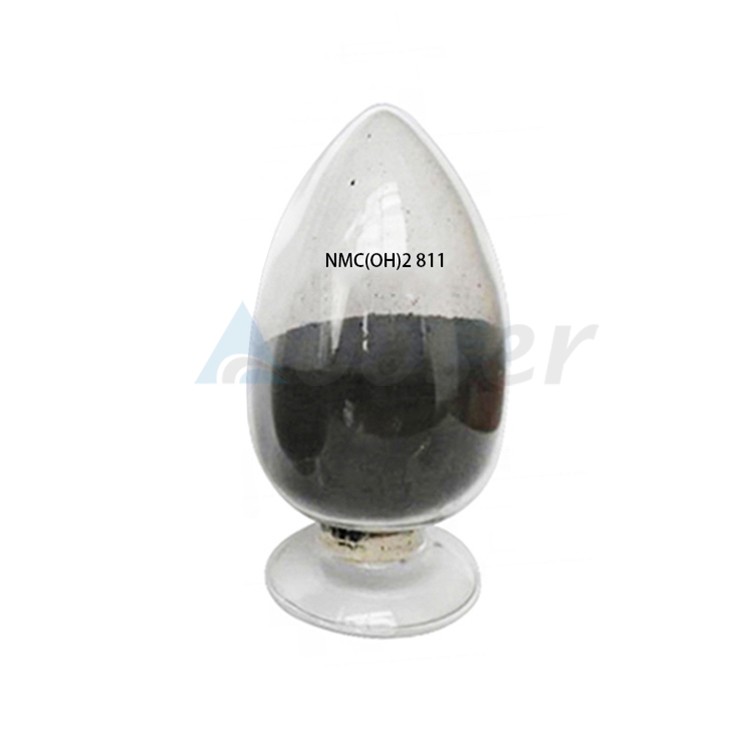
Bare, uncoated NMC 811 powder — often described in the literature as “pristine” or “bare” material — is supplied as a gray-black powder with a tap density typically ranging from 1.75 to 2.46 g/cm³ and particle sizes (D50) between 3.6 and 14 µm, depending on whether the material is single-crystal or polycrystalline. The material is highly moisture-sensitive and alkaline, requiring storage in an inert atmosphere to prevent surface degradation.
Why Bare Powder Matters
Despite the growing popularity of surface-coated and doped NMC 811 variants, the bare, uncoated powder remains irreplaceable in battery R&D for one fundamental reason: it establishes the performance baseline. Without a pristine reference, researchers cannot quantify the benefits of a given coating or doping strategy.
Recent research underscores this point. A 2026 study published in the Journal of Energy Storage comparing carbon-coated NMC 811 via ball-milling found that pristine NMC 811 delivered an initial discharge capacity of 150.48 mAh/g, while Super P carbon-coated NMC achieved 201.12 mAh/g — a 33.6% improvement attributable directly to the coating. However, the same study revealed that non-uniform coatings led to capacity fading during cycling, with graphene-coated NMC showing only 77.48% capacity retention after 50 cycles. These findings highlight why bare powder benchmarking is essential: without it, the true efficacy of coating strategies cannot be assessed.
Similarly, research on polyacrylonitrile-based carbon coatings has demonstrated that the potential disparity between redox peaks — a key indicator of electrochemical reversibility — is 0.9 for bare NMC 811 versus 0.4 for the coated variant. The bare material also exhibits a more significant decline in lithium diffusion coefficient after 100 cycles, dropping from 9.5 × 10⁻⁷ to 0.05 × 10⁻⁷ cm²/s, compared to coated NMC 811, which retains a diffusion coefficient of 3.0 × 10⁻⁷ cm²/s.
The Core Challenges of Bare NMC 811
Bare, uncoated NMC 811 powder presents three well-documented degradation challenges that researchers must address:
Cation mixing (Li/Ni disordering): Because lithium and nickel ions are similar in size, some nickel ions occupy lithium sites in the crystal structure, interfering with lithium diffusion pathways and contributing to capacity fade over cycling.
Microcracking: As NMC 811 particles are repeatedly delithiated and relithiated, especially at high cutoff voltages, primary particles within polycrystalline secondary particles develop cracks between grains. These cracks expose fresh internal surface area to the electrolyte, accelerating side reactions and further capacity loss.
Residual lithium compounds: The chemical instability of bare NMC 811 during air exposure leads to the formation of residual lithium compounds — LiOH and Li₂CO₃ — on the particle surface, which can inhibit practical application and trigger unwanted side reactions.
Market Momentum and Supply Chain Developments
The broader market for high-nickel NMC cathodes is expanding rapidly. The high-nickel NMC (811, 9.5.5) cathode market was valued at USD 3.2 billion in 2025 and is projected to reach USD 19.9 billion by 2035, expanding at a CAGR of 19.8% from 2026 to 2035. Asia Pacific dominates the market, with key players including EcoPro BM Co., Ltd., POSCO Future M, Umicore SA, LG Chem Ltd., and Ningbo Ronbay New Energy Technology Co., Ltd. collectively holding a 62% market share in 2025.
For research-grade bare NMC 811 powder, pricing remains accessible for laboratory-scale work. Ossila offers NMC 811 powder at $180 per 50g, while ATOMFAIR supplies research-grade NCM 811 (Ni83) powder with 205.35 mAh/g discharge capacity at $244–$317 depending on quantity. At the industrial scale, NMC 811 cathode material traded at approximately 200,600 RMB per ton as of August 2026, with production costs estimated at 193,400 RMB per ton.
The Path Forward
As the battery industry pushes toward cell-level energy densities of 300 Wh/kg and beyond, bare NMC 811 powder will continue to serve dual roles: as the foundational reference material in R&D laboratories worldwide and as the starting point for the next generation of surface-engineered cathode materials. The gap between the theoretical 250 mAh/g capacity and the practical performance of bare NMC 811 — typically 185–200 mAh/g — remains the central challenge driving innovation in doping, coating, and single-crystal synthesis strategies.
For researchers and manufacturers alike, the message is clear: the bare powder is not merely a commodity — it is the benchmark against which all cathode innovation is measured.
Contact: Jason Wang
Phone: 13580725992
E-mail: sales@aooser.com
Whatsapp:13580725992
Add: No.429 Guangming Road, Shenzhen City, Guangdong Province
We chat