
sales@aooser.com
13580725992
Introduction
With the rapid iteration of new energy storage technologies, aqueous zinc-ion batteries and zinc-air batteries have become key research focuses for material laboratories worldwide, thanks to their outstanding strengths including high safety, low cost and environmental friendliness. As the core carrier for electrochemical testing, electrode substrates directly determine the repeatability of experimental data and the credibility of research outcomes by virtue of their purity, dimensional accuracy and mechanical properties. Recently, a standardized 4N high-purity zinc foil specially developed for scientific research has been officially released to the market. Featuring stable physical and chemical parameters, standard base specifications and full-size customization services, this product provides standardized, highly compatible electrode substrate solutions for energy electrochemistry research groups in universities and research institutes, filling the gap in standardized experimental materials for zinc-based energy storage research.
As a Group IIB transition metal in the 4th period of the periodic table, zinc naturally boasts a silvery-white surface with a faint bluish tint, a density of 7.14 g/cm³ and a melting point of 419.5°C. Its unique mechanical properties varying with temperature enable its application in various sample preparation scenarios: it appears brittle at room temperature, yet gains great ductility between 100°C and 150°C, making it easy to cut and bend for electrode fabrication. When the temperature exceeds 200°C, zinc turns brittle again, adapting to special experimental conditions such as high-temperature sintering and interface modification. Owing to its excellent intrinsic electrochemical activity, zinc metal has long held an irreplaceable core position in battery manufacturing, serving as an indispensable base material for research on aqueous energy storage, metal corrosion and electrodeposition mechanisms. Conventional industrial-grade zinc materials contain excessive impurities. Trace elements such as lead, iron and copper can trigger side reactions in electrolytes and generate spurious redox peaks, which severely interfere with precision electrochemical tests including cyclic voltammetry (CV), linear sweep voltammetry (LSV) and galvanostatic charge-discharge, restricting the experimental stability of cutting-edge research on zinc-based battery mechanisms.
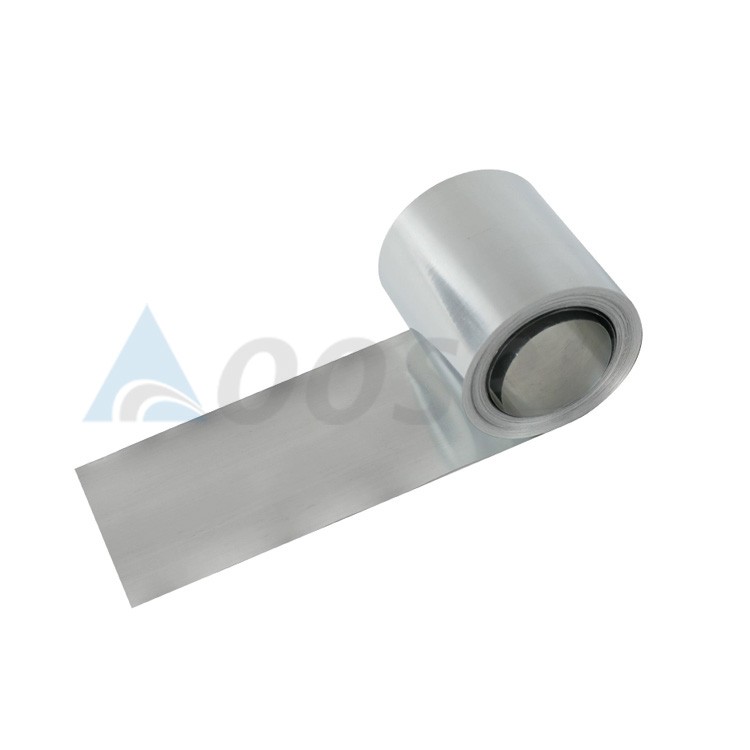
Rigorous Raw Material Control for Ultra-High Purity to Eliminate Experimental Errors at the Source
This newly launched research-oriented zinc foil is rolled from smelted pure zinc metal, with a stable zinc content reaching 99.99% (4N high-purity standard). The total content of heavy metal and non-metallic impurities is stringently limited, far exceeding common industrial zinc plates and ordinary zinc foils available on the market. For electrochemical experiments, trace impurities can form micro-galvanic cells during charge and discharge, accelerating zinc foil corrosion, inducing severe hydrogen evolution side reactions and aggravating the disordered growth of zinc dendrites. These issues drastically shorten the cycle life of symmetric cells and lead to highly discrete data across parallel experiments, making it difficult to replicate research conclusions published in authoritative journals.
The high-purity zinc foil is processed with vacuum distillation purification to remove harmful impurities inside raw materials. After rolling, it undergoes double-sided mirror polishing and degreasing cleaning, delivering a surface free of oil stains, oxide scales, pinholes and internal slag inclusions, so that zinc ion dissolution and deposition can proceed uniformly and controllably. Actual measurements conducted in material laboratories of multiple domestic universities show that symmetric cells assembled with negative electrodes made of this 99.99% high-purity zinc foil achieve over three times longer stable cycling at a current density of 1 mA·cm⁻² compared with cells using 99.5% industrial zinc materials, while the fluctuation range of polarization voltage drops by 70%. It significantly improves the reversibility of zinc deposition/stripping, perfectly matching all types of scientific research tests including aqueous zinc-ion batteries, flexible zinc-air batteries, zinc-based supercapacitors, metal corrosion mechanism analysis and electrocatalytic reduction.
Standardized Precision Dimensions with Full-Range Customization Support
The product adopts a standard factory specification of 100 mm in width and 1000 mm in length, with a fixed base thickness of 0.08 mm. This thickness balances electrode flexibility and structural stability, making it the most widely adopted universal dimension for laboratory use. The ultra-thin 0.08 mm foil can be easily cut into standard working electrodes of various sizes such as 10 mm×10 mm, 15 mm×20 mm and 20 mm×20 mm, compatible with three-electrode electrolytic cells of 5–150 mL capacity, quartz thin-layer spectroelectrochemical cells and supporting test systems for rotating disk electrodes. The thin foil is lightweight and bendable, and can be fabricated into cylindrical surrounding electrodes and L-shaped bent electrodes, perfectly matching supporting experiments with porous counter electrodes such as nickel foam and iron foam.
To meet differentiated research demands, the production line supports full-dimensional customization, including adjustable width, length and thickness. Custom square, circular, long strip and special-shaped zinc electrode sheets can be mass-produced, eliminating secondary precision machining in laboratories and reducing surface scratches, edge burrs and other defects caused by manual cutting. Narrow zinc strips specially for spot welding are also available on demand, which can be directly welded to titanium or platinum leads to avoid current noise and excessive IR drop arising from poor contact via electrode clamps. The standardized coil is packed in moisture-proof vacuum sealing to prevent oxidation by air, retaining the native metallic luster after unpacking. It can be directly applied to electrochemical tests without complicated pre-treatment, greatly cutting down sample preparation time for researchers.
Compatible with a Full Spectrum of Cutting-Edge Research Scenarios to Drive Innovative Industrialization of Energy Storage Technology
Defined exclusively for scientific research by virtue of its stable purity and dimensional advantages, this high-purity zinc foil targets core experimental demands of material schools, energy laboratories, new energy research institutes and enterprise R&D centers across domestic universities, covering four major research directions as follows.
First, research on negative electrode mechanisms of aqueous zinc-ion batteries. Global research teams are currently focusing on dendrite suppression, interfacial protective layer construction and electrolyte modification. High-purity zinc foil can eliminate impurity interference, enabling precise observation of the micro-morphology of zinc crystal deposition, supporting the development of novel modification schemes such as textured zinc electrodes at millimeter scale and gradient concave zinc anodes, and facilitating the research and development of long-cycle, high-reversibility zinc-based energy storage devices.
Second, development of zinc-air batteries and flexible solid-state batteries. The 0.08 mm thin zinc foil features moderate flexibility, applicable to prototype fabrication of flexible wearable batteries, and serves both as a current collector and an active negative electrode. It delivers a stable electron conduction pathway with low impedance, and is used to study the matching performance of solid electrolytes and hierarchically porous air cathodes, boosting the power density and cycling stability of flexible energy storage devices.
Third, standard fundamental electrochemical testing. Paired with platinum mesh counter electrodes and Hg/HgO alkaline reference electrodes, it can conduct CV, electrochemical impedance spectroscopy (EIS), galvanostatic charge-discharge, long-term stability tests in neutral and alkaline electrolyte systems such as KOH and LiOH zinc sulfate. The high-purity substrate avoids spurious peaks and guarantees accurate and reliable electrochemical spectra, meeting the strict data standards required for academic papers.
Industrial Value: Promoting Standardization of Scientific Research Electrode Materials
For a long time, domestic laboratories faced scattered procurement channels for zinc electrode materials, accompanied by inconsistent purity, non-standard dimensions and varying surface conditions of industrial zinc products. Variables cannot be unified across batches of experiments within one research group or parallel verification tests in different universities, raising trial-and-error costs for scientific research. The launch of standardized high-purity zinc foil establishes a unified quality standard for research-grade zinc electrodes with consistent purity, thickness and surface treatment processes. It provides researchers nationwide with universally applicable, comparable standardized experimental substrates, lowering the difficulty of reproducing research outcomes across laboratories.
From a long-term industrial perspective, aqueous zinc-based batteries represent a core alternative for large-scale energy storage, household energy storage and portable flexible power supplies. As a fundamental experimental consumable, high-purity zinc foil continuously delivers underlying support for the iteration of new energy storage materials.
Contact: Jason Wang
Phone: 13580725992
E-mail: sales@aooser.com
Whatsapp:13580725992
Add: No.429 Guangming Road, Shenzhen City, Guangdong Province
We chat