
sales@aooser.com
13580725992
1. Introduction
With the rapid development of the new energy industry, lithium battery performance indicators such as energy density, cycle life, charging speed, and safety have been raised to unprecedented heights. Electrolyte quality directly determines the internal resistance, capacity retention rate, and thermal stability of lithium batteries. The mainstream lithium battery electrolyte consists of organic carbonate solvents (such as ethylene carbonate, dimethyl carbonate, and ethyl methyl carbonate) and lithium salts (mainly lithium hexafluorophosphate, LiPF₆).
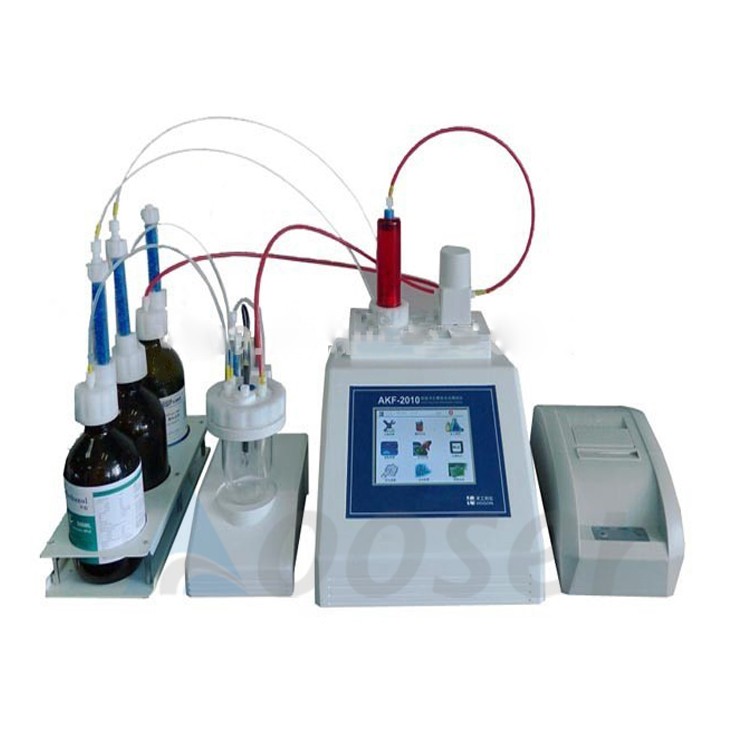
2. Working Principle of the Intelligent Karl Fischer Moisture Analyzer
2.1 Chemical Reaction Basis
The Karl Fischer (KF) titration is based on a specific and quantitative redox reaction between water, iodine, sulfur dioxide, organic base, and alcohol solvent. The core reaction equation is as follows: I₂ + SO₂ + H₂O + 3RN + CH₃OH → 2RN·HI + RN·HSO₄CH₃ In this reaction, 1 mole of water reacts quantitatively with 1 mole of iodine. The water content can be calculated by measuring the consumption of iodine. For lithium battery electrolyte trace moisture analysis, the instrument adopts the coulometric Karl Fischer titration mode, which generates iodine in situ through electrolysis of iodide ions in the reagent, rather than adding iodine-containing titrant manually. The anode reaction is: 2I⁻ → I₂ + 2e⁻.
2.2 Endpoint Detection Mechanism
The instrument is equipped with a dual platinum electrode system to realize potentiometric endpoint detection. During the titration, the generated iodine is immediately consumed by water in the electrolyte sample, and the concentration of free iodine in the titration cell is extremely low, resulting in a low and stable polarization current between the platinum electrodes. When all water molecules react completely, free iodine accumulates rapidly, causing a sharp jump in the current signal. The intelligent control module captures this mutation instantaneously and automatically stops electrolysis, so as to determine the titration endpoint accurately.
2.3 Intelligent Control and System Composition
The intelligent Karl Fischer moisture analyzer integrates a microprocessor control unit, sealed titration cell, dual platinum electrode, electrolysis electrode, magnetic stirring system, automatic sample injection module, and human-computer interaction interface. The sealed titration cell is designed to isolate ambient moisture and prevent secondary contamination, which is crucial for detecting ppm-level moisture in electrolyte. The intelligent control system realizes full automation of reagent replacement, baseline drift compensation, temperature control, data calculation, result storage, and report export.
3. Core Functions and Technical Advantages in Lithium Battery Electrolyte Analysis
3.1 Ultra-high Sensitivity and Trace Detection Capability
The coulometric intelligent Karl Fischer moisture analyzer has a detection limit as low as 0.1 ppm and a measurement range of 0.1 μg to 100 mg water, which fully meets the strict control requirements of moisture in lithium battery electrolytes (usually ≤ 20 ppm). Compared with other analytical techniques, it can accurately quantify trace moisture without sample dilution or complex pretreatment, and is suitable for incoming inspection of electrolyte raw materials, on-line monitoring of production processes, and quality sampling of finished products.
3.2 Strong Specificity and Anti-interference Ability
The Karl Fischer reaction has high selectivity for water and does not react with organic solvents, lithium salts, or additives in the electrolyte. Even if the electrolyte contains trace impurities such as vinylene carbonate (VC) and fluoroethylene carbonate (FEC), it will not interfere with the moisture detection results. This characteristic ensures the accuracy and authenticity of the test data and avoids false positives or false negatives in quality control.
3.3 Intelligent and Automated Operation
The instrument supports automatic sample injection, automatic titration, automatic endpoint judgment, and automatic data output. Operators only need to inject the electrolyte sample into the sealed titration cell through a syringe, and the instrument can complete the entire detection process independently, reducing human error and improving detection efficiency. The built-in self-checking function can monitor the status of reagents, electrodes, and sealing performance in real time, and send an alarm prompt for abnormal conditions, ensuring the continuity and reliability of detection.
3.4 Good Stability and Reproducibility
The intelligent control system optimizes the electrolysis current, stirring speed, and temperature control parameters to ensure the stability of the reaction system. The relative standard deviation (RSD) of repeated measurements is less than 1%, meeting the high-precision and high-repeatability requirements of lithium battery batch quality control. In addition, the instrument has a long reagent service life and low operating cost, which is suitable for long-term continuous use in industrial laboratories.
4. Application Value of the Instrument in Lithium Battery Industry
4.1 Raw Material Quality Control
In the lithium battery industry chain, electrolyte manufacturers and battery cell factories must conduct moisture testing on incoming solvents, lithium salts, and finished electrolytes. The intelligent Karl Fischer moisture analyzer can quickly and accurately screen unqualified raw materials, prevent moisture-exceeding products from entering the production process, and lay a foundation for the stability of battery performance.
4.2 Production Process Monitoring
During electrolyte preparation and battery cell injection, trace moisture may be introduced due to equipment sealing, environmental humidity, and operational errors. The instrument can realize real-time on-line monitoring, timely detect moisture anomalies, adjust process parameters, avoid batch quality accidents, and improve the yield and consistency of battery products.
4.3 Battery Performance and Safety Assurance
By strictly controlling the moisture content in the electrolyte, the formation of HF can be effectively suppressed, the corrosion of electrode materials and current collectors can be reduced, the integrity of the SEI film can be protected, the cycle life of the battery can be prolonged, and the internal resistance can be reduced. More importantly, controlling moisture within a safe range can avoid gas production, swelling, and thermal runaway caused by chemical reactions, and fundamentally improve the safety performance of lithium batteries.
4.4 Failure Analysis and Research and Development Support
In battery failure analysis, the instrument can detect the moisture content in failed batteries, analyze the correlation between moisture contamination and capacity attenuation, short circuit, and liquid leakage, and provide data support for failure mechanism research. In the research and development of new electrolytes (such as high-voltage electrolytes, solid-state electrolytes), the instrument provides accurate moisture data, promotes the optimization of formula and process, and accelerates the iteration of new battery technologies.
With the continuous upgrading of lithium battery technology and the increasingly strict quality standards, the intelligent Karl Fischer moisture analyzer will play a more important role in the fields of raw material inspection, process control, quality certification, and research and development innovation, and become an indispensable analytical instrument in the lithium battery industry chain.
Contact: Jason Wang
Phone: 13580725992
E-mail: sales@aooser.com
Whatsapp:13580725992
Add: No.429 Guangming Road, Shenzhen City, Guangdong Province
We chat